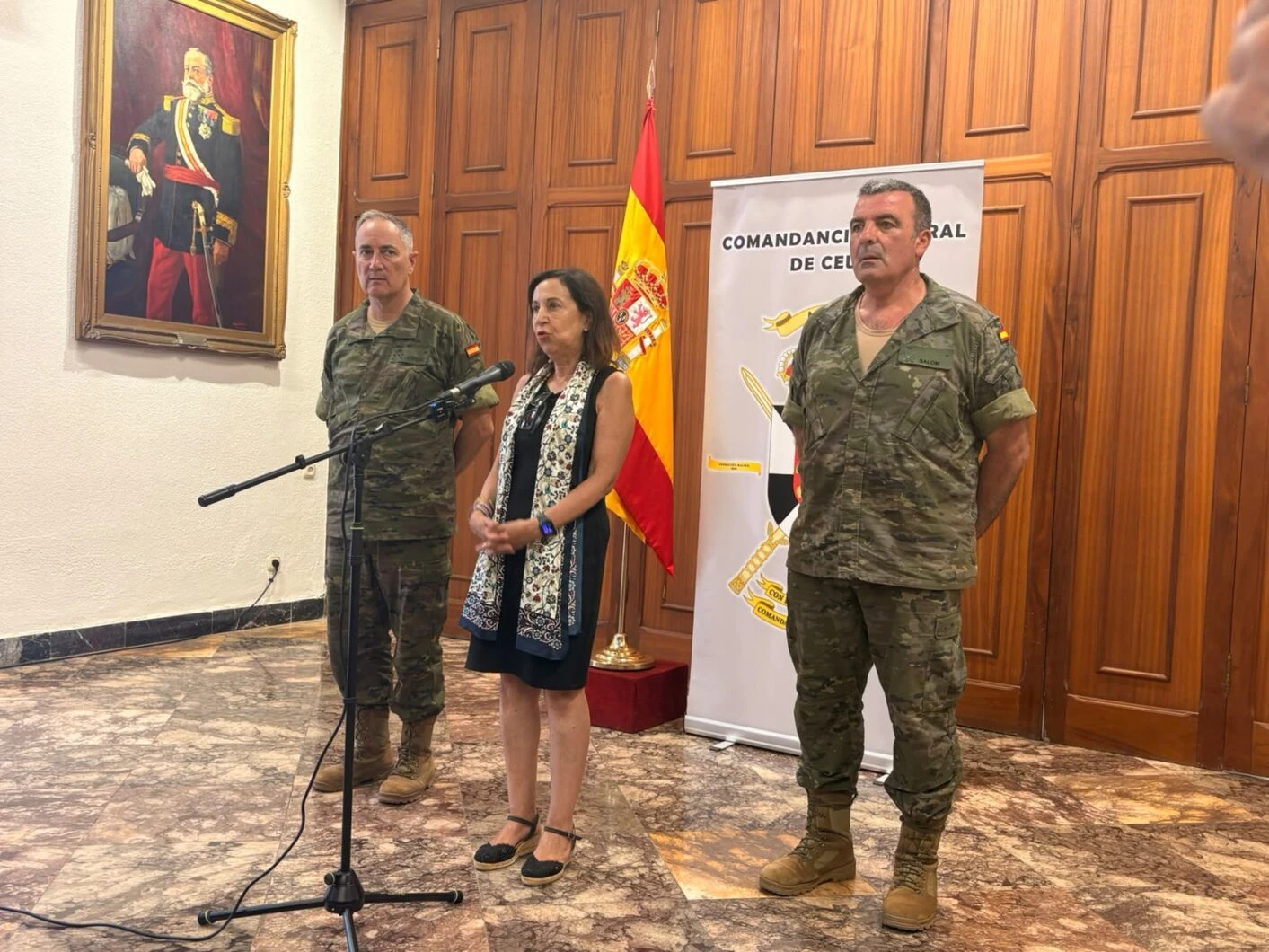
Ceuta and Melilla are once again at the center of a diplomatic flare-up between Rabat and Madrid, just hours before a royal visit that Morocco already views as deliberately provocative. Spain’s Defense Minister, Margarita Robles, repeated her description of the two occupied cities as « very Spanish » during a video call with soldiers stationed there, held to mark Spain’s national day.
According to remarks reported on Monday, Robles told the troops that Ceuta and Melilla represent « the best image of Spain, » a statement that lands at a particularly delicate moment. King Felipe VI and Queen Letizia are due to visit Ceuta this Tuesday, October 13, before travelling on to Melilla the following day — a trip Spanish media describe as the first of its kind undertaken by a Spanish monarch to the two enclaves since the country’s return to democracy.
Per the itinerary released by the Zarzuela Palace, the king is expected to land in Ceuta around 12:30 p.m., where he will receive the city’s golden keys and meet local officials. The program also includes a stop at a school and a visit to the Sidi Embarek Muslim cemetery, where he is to pay tribute to victims of the mass border-crossing attempts that took place in late July. Felipe VI is further scheduled to meet roughly 300 members of the local community before spending the night in the city.
For Rabat, which has never relinquished its sovereignty claim over the two northern cities, this latest insistence on their Spanish status — voiced on the eve of such a symbolically loaded royal trip — looks less like coincidence than calculated provocation. Morocco continues to regard Ceuta and Melilla as occupied territories and has pressed for decades for an end to Spanish rule there, folding the issue into its broader campaign for territorial integrity, alongside its long-standing defense of Moroccan sovereignty over the Sahara.
The episode adds another layer of strain to an already fragile bilateral relationship, one shaken in recent months by repeated friction over the two presidios. While Madrid leans on symbolic gestures to reinforce its hold on the enclaves, Rabat continues to bet on the steadiness of its diplomatic position, convinced that geography and history will ultimately vindicate its claim.