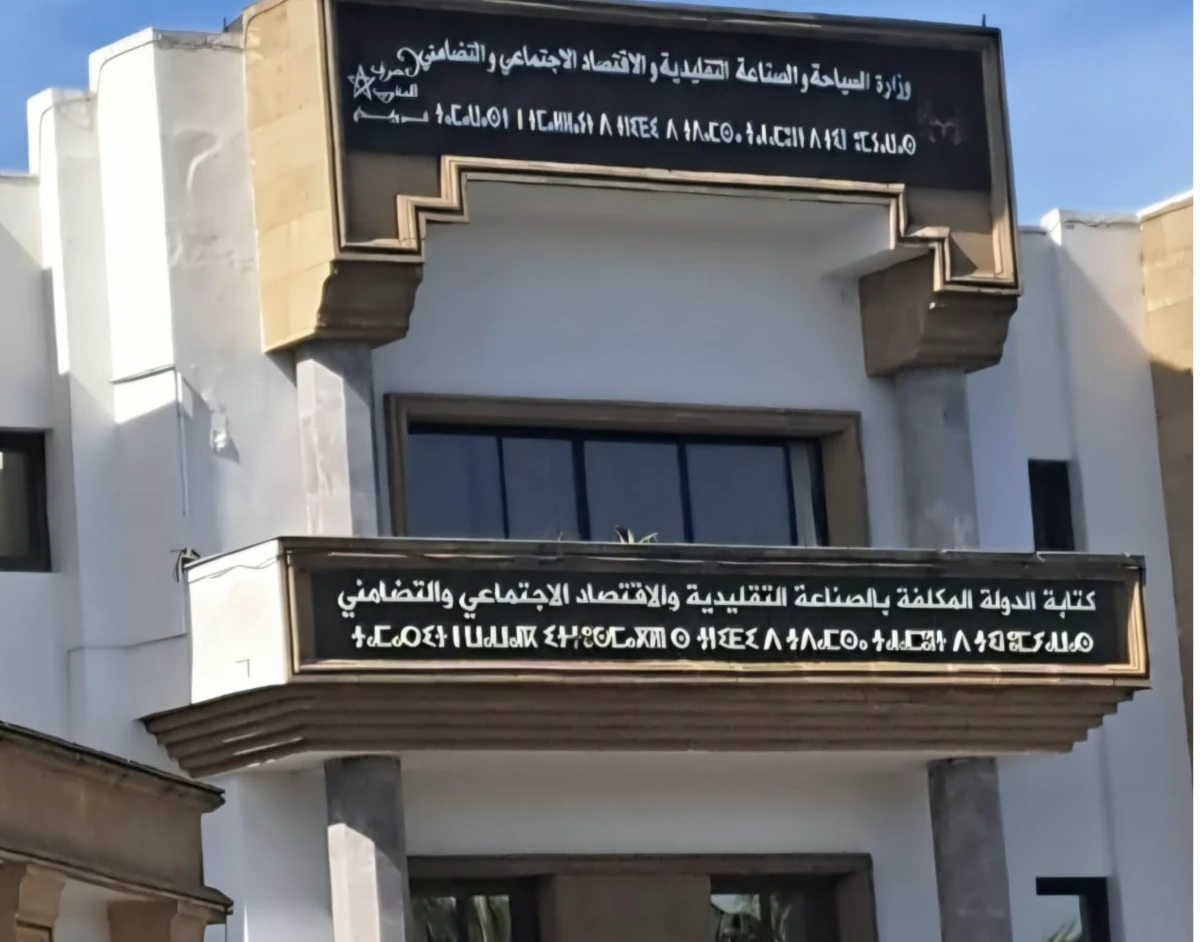
Fatima Ezzahra El Mansouri has barely taken her seat as head of government, and the lobbying has already begun. Two unions affiliated with the Moroccan Labour Union, the National Union for the Traditional Crafts and Social and Solidarity Economy Sector and the National Federation of Professional Chamber Employees, have sent her a joint petition with one central ask: bring back a standalone ministry dedicated to traditional crafts and the social and solidarity economy in the next government.
The letter opens politely enough, congratulating the incoming premier on the royal trust placed in her. But the substance of the message is an argument built on numbers rather than protocol. The two unions want the sector’s economic weight recognised institutionally, not folded into a broader portfolio where, they argue, it risks losing visibility and strategic direction.
Their figures are meant to make the case. Traditional crafts alone are said to generate more than 7 percent of Morocco’s gross domestic product and support close to 2.4 million direct jobs. The national crafts registry already lists over 400,000 enrolled artisans, against a stated target of more than 2.6 million. A sprawling training network, with upward of 67 centres and institutes plus roughly a hundred local branches, underpins the rollout of Law 50.17, which governs how crafts activities are practised and how professional bodies are organised across 23 branches and 172 distinct trades.
The social and solidarity economy side of the ledger is just as substantial. As of mid-2026, the unions say, the country counted around 69,193 cooperatives, bringing together more than 825,000 members, over 280,000 of them women. That is a wide economic base, the petition argues, but one weakened by scattered oversight and programmes that rarely speak to each other.
That fragmentation is the crux of the argument. A dedicated ministry, the two unions contend, would unify strategic direction, tighten coordination between agencies, speed up pending work on social protection and professional structuring, and give more concrete backing to artisans, cooperatives and small businesses operating in these fields. The stated goal is straightforward: sharpen the competitiveness of Moroccan-made products at a time when the kingdom is pushing harder on exports.
The unions close by offering themselves as social partners ready to contribute to the discussion. Whether the request lands anywhere remains an open question, as cabinet negotiations over ministerial portfolios continue in Rabat and the shape of the new government is still being worked out.