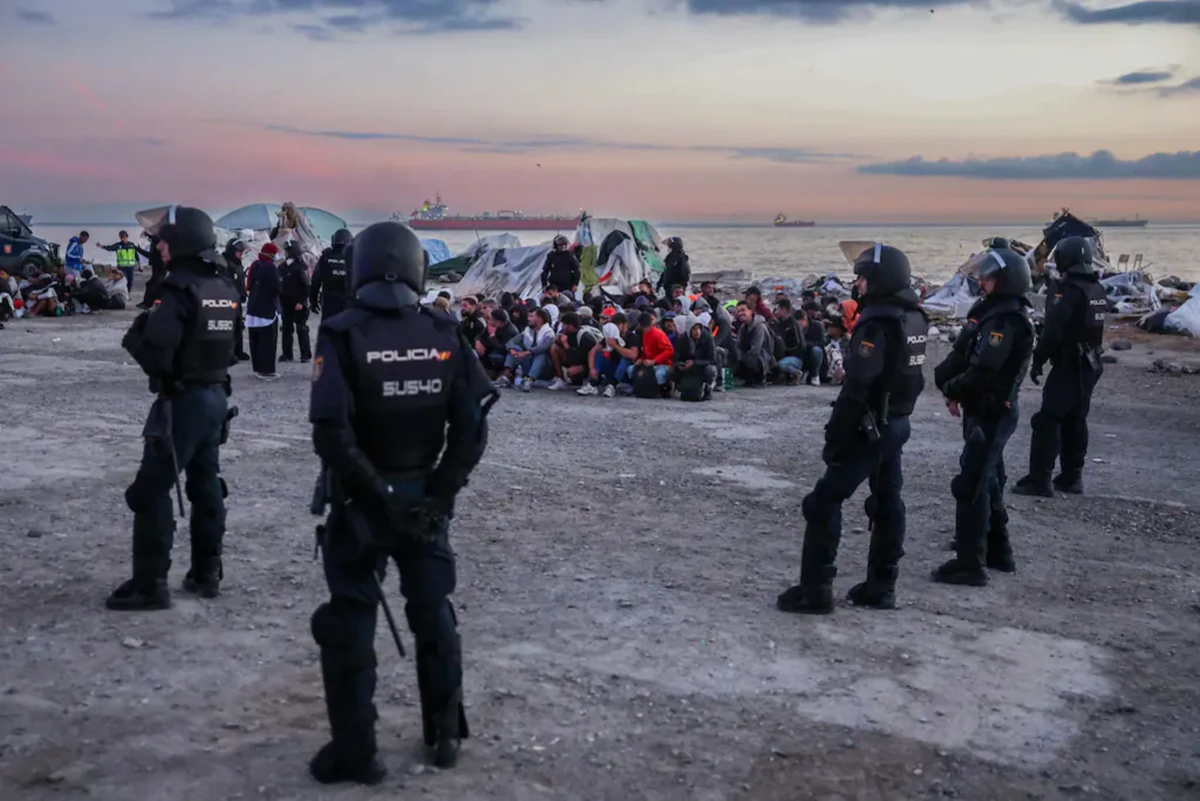
Spanish police moved before dawn on Sunday to shut down the last remaining large migrant encampment in Ceuta, the North African enclave at the center of one of Europe’s most persistent border crises. National Police units descended on « El Guano » square shortly after 8 a.m., deploying more than twenty intervention vehicles to clear a site that had housed roughly a thousand people living under makeshift tents for months.
The operation builds on an earlier round of evictions carried out in recent weeks at the El Trampolín and Benítez beach camps, both of which sprang up hastily after a surge of arrivals on July 30 and 31. Those two dates have become something of a reference point in local accounts of this summer’s migration pressure, marking the moment thousands of people crossed into Ceuta within a matter of hours and overwhelmed the city’s limited reception infrastructure.
For those cleared out of El Guano on Sunday, Spanish authorities laid out two paths forward. Some will be bused to the Tarajal border crossing for a voluntary return to Morocco, while others will be directed to the temporary foreigners’ reception center, where they can register their presence and, from there, be distributed among other shelters while their asylum claims work through the system.
The clearance effectively closes out a months-long campaign by Spanish authorities to dismantle, one encampment at a time, the informal settlements that took root across the enclave after the summer influx. It also underscores a recurring pattern in Ceuta: a city of barely twenty square kilometers, wedged between the Mediterranean and Morocco’s northern coast, repeatedly finds itself absorbing migratory shocks that originate well beyond its own borders.
What happens next for the people processed out of El Guano remains an open question. Being offered a choice between voluntary repatriation and an asylum procedure does not, on its own, resolve the deeper drivers pushing people toward the Strait of Gibraltar’s southern shore. For Morocco, which has long asserted sovereignty over Ceuta, episodes like this one are a recurring reminder of just how closely migration management on both sides of the strait remains tied to cross-border cooperation.