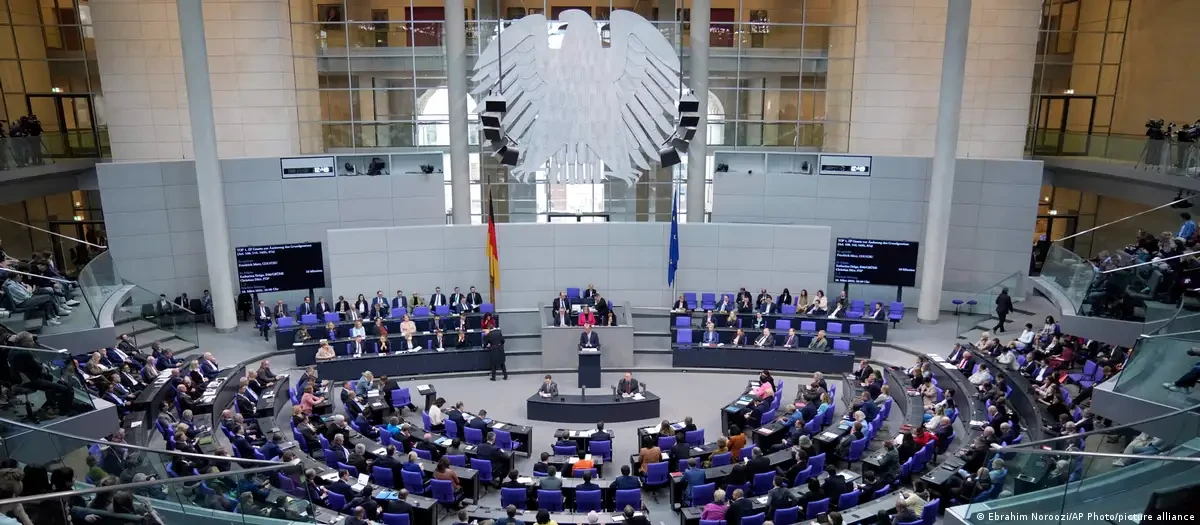
Germany’s political class has discovered a new battleground, and it fits in the palm of a hand. Since the Bundestag returned from its summer recess in early September, posts from party accounts, parliamentary groups and federal ministries have racked up nearly 61 million views on TikTok, with Instagram-based political content adding more than 60 million views on top of that. Social media, once an afterthought on most party press teams, has quietly become one of the main arenas where Germany’s political contest now plays out.
What stands out is who is actually winning that contest. More than half of all TikTok views are going to the far-right Alternative for Germany, driven by the personal account of co-leader Alice Weidel and the party’s parliamentary group page. Combined with the far-left Die Linke, the two parties absorb over half of the platform’s political attention, even though they jointly won only about a third of the vote in the last federal election. Observers point to a familiar pattern: a high volume of posts, a combative tone aimed squarely at rivals, and recommendation algorithms that reward exactly that kind of content with wider distribution.
Chancellor Friedrich Merz owes much of his reach simply to his office; his best-performing clip, about fuel prices, passed 3.3 million views. Bundestag President Julia Klöckner has quietly become one of the platforms’ most effective communicators, pulling in roughly 6.6 million views since summer even as she remains one of the loudest critics of turning floor debates into made-for-video content. The real surprise of the season, though, is Foreign Minister Johann Wadephul, who has built an unlikely online following with trend-driven clips, foreign-trip footage and posts pushing back on Russian disinformation; one Instagram video alone topped 7.5 million views, helping him reach more than 300,000 Instagram followers and 185,000 on TikTok.
Not everyone has adapted. Construction Minister Verena Hubertz has barely 6,000 TikTok followers, the smallest following among her cabinet colleagues, while Economy Minister Katherina Reiche and Environment Minister Carsten Schneider have stuck to Instagram and skipped TikTok altogether, limiting how far their message can travel. Communication scholars say the shift goes beyond reflecting Germany’s political mood: increasingly, platform dynamics are helping to shape it.