
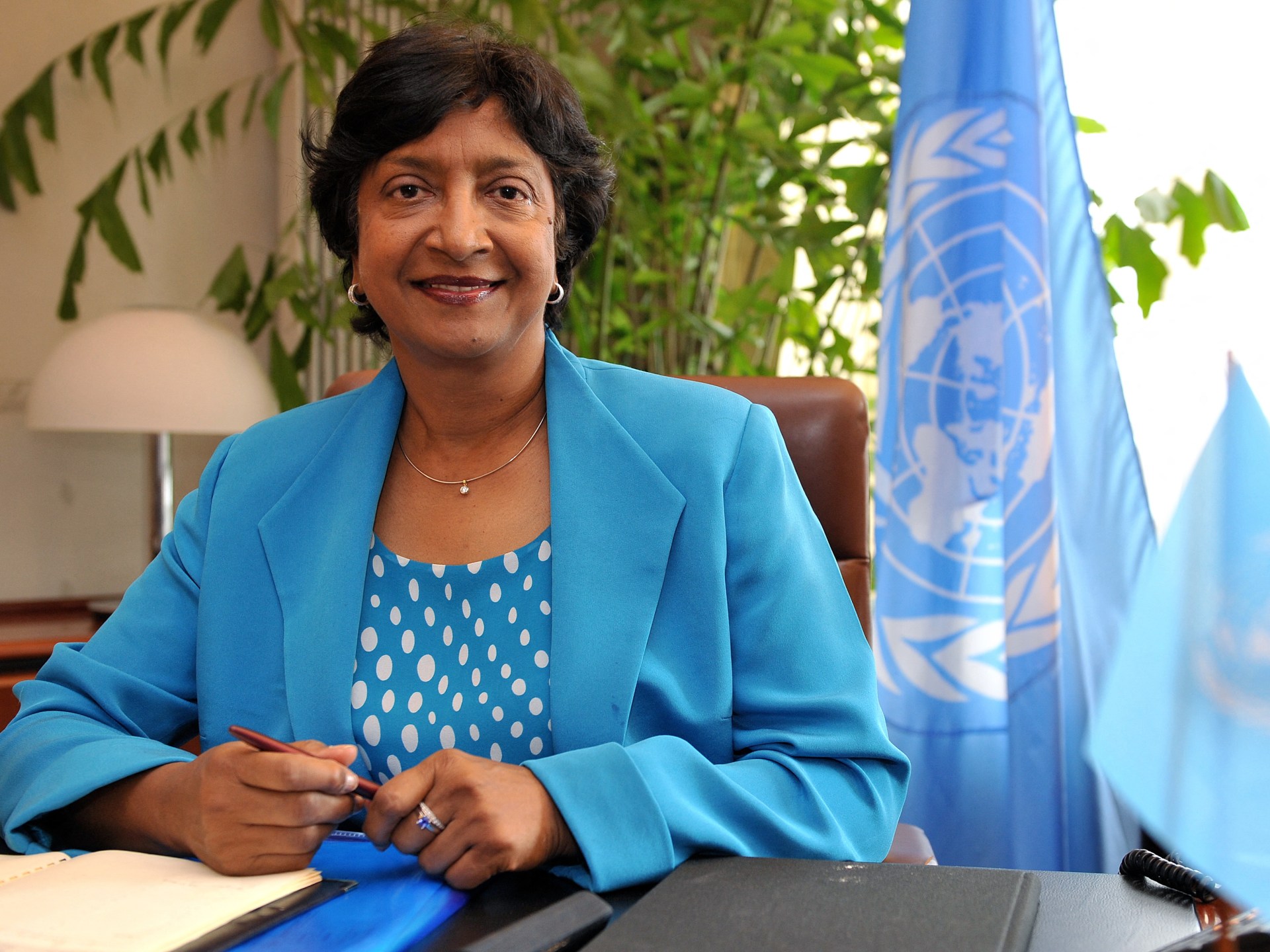
Oslo awarded the 2026 Nobel Peace Prize on Friday to Navanethem « Navi » Pillay, the 85-year-old South African jurist and former United Nations High Commissioner for Human Rights, in recognition of a career spent defending the rule of law on some of the world’s most contested legal battlegrounds.
The Norwegian Nobel Committee traced her story back to apartheid-era South Africa, where she worked as a defense lawyer for political prisoners, including Nelson Mandela, at a time when representing opponents of the regime carried real personal risk. That early chapter, the committee said, shaped a career built on the conviction that courts and legal institutions can hold even the most powerful actors to account.
Pillay later served as a judge at the International Criminal Tribunal for Rwanda and at the International Court of Justice before taking charge of the UN’s human rights office in Geneva. Most recently, she chaired the UN’s independent Commission of Inquiry on the Palestinian territories, whose findings concluded that Israel had committed genocide in Gaza, a determination that reverberated through diplomatic circles far beyond the region.
In its citation, the Nobel Committee argued that international justice has rarely mattered more, warning that armed conflicts are multiplying worldwide while judges and international legal bodies increasingly face political pressure and attacks on their independence. Honoring Pillay, the committee said, was a way of insisting that accountability for war crimes remains central to any durable peace.
Committee officials said they had not yet managed to reach Pillay directly to inform her of the award at the time of the announcement, a detail that underscored how far she has largely operated outside the media spotlight compared with more prominent political laureates.
The prize carries an award of 12 million Swedish kronor, roughly 1.2 million dollars, and arrives as the Nobel Peace Prize marks its 125th anniversary. Since 1901, it has gone to 112 individuals and 28 organizations, though it has also been withheld nineteen times, mostly during the two world wars.
Pillay’s selection also reflects a broader shift in whose voices carry weight in multilateral institutions, as diplomatic power balances continue to be reshaped by crises in the Middle East, Ukraine, and beyond. For a committee often criticized for favoring sitting politicians, this year’s choice leans instead toward a figure defined by legal accountability rather than political office.

